

Just last week I was reminded of an experience I had at a previous employer with an import shipment. It was the Wednesday before Thanksgiving, and many people were already on their holiday, while I received a frantic call from our freight forwarder & customs broker about an Emergency Action Notification (EAN) from U.S. Customs & Border Protection or USDA/APHIS. The EAN stated that a shipment was held due to invasive species being found. The options given were to treat the shipment (fumigate), re-export, or destroy the shipment. Within this blog, I’ll be breaking down what’s needed to respond and react to an EAN.
When an Emergency Action Notification Hits
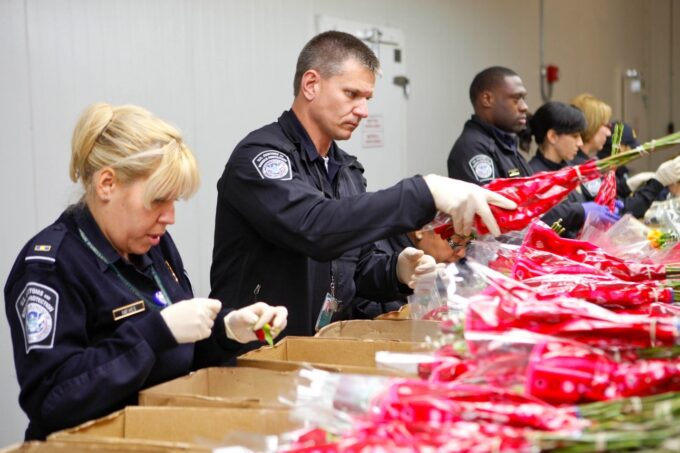
With Valentine’s Day just a few days away, U.S. Customs has been busy inspecting imports of cut flowers. Fun fact: cut flowers are listed on the J-list in the 19 CFR. The J-List is a list of commodities that are exempt from containing a country of origin marking, meaning the flowers you import do not need to be stamped or imprinted with a “Made in USA”.
US Customs reports that as the busiest season for flower imports approaches, CBP has already inspected more than 1 billion cut flowers, intercepting over 600 harmful pests and plant diseases from hitch-hiking into the United States. By the time Valentine’s Day arrives, CBP expects to top last year’s record of 1.3 billion stem inspections.
CBP is inspecting shipments regularly for pests, not just when Valentine’s Day looms.
Why CBP Inspections Matter More Than You Think
So why is it so important to inspect shipments as they arrive? What is CBP looking to accomplish? CBP screens shipments for invasive plants, pests, or animal products. Invasive species pose major threats to the U.S. Agriculture.
The EAN I received years ago was issued because there was a type of snail found on the containers & flat racks transporting the goods. Step one was to safeguard the shipment; this resulted in the most expensive purchase of salt treatment I’ve ever seen. The cost for this was $14K, but when CBP stops a shipment and issues an EAN, the importer has few options left: treat, re-export, or destroy.
Because the product was a valuable shipment to the company, the only option the business felt they had was to treat the shipment, and with Thanksgiving looming, no fumigators were available that weekend to perform the fumigation. The shipment was surrounded with salt to prevent the snails from entering or sliming over to U.S. soil, and then fumigated the following week. The fumigation cost the business another $15K.
Shipments with infestations or even evidence of pests can be costly and disrupt your imports.
In March 2025, CBP reported a seized shipment being transported by vehicle from Mexico containing 22 rolls of bologna. The shipment was destroyed, and the U.S. Citizen who was transporting the shipment could face up to $10,000 if found guilty.
In January 2026, CBP intercepted a shipment containing khapra beetle remains in Detroit Metropolitan Airport. The khapra beetle is the world’s most invasive grain pest. Infestations of this beetle, when it enters warehouses or granaries, cause stored products to be inedible. This can rapidly devastate our nation’s agricultural economy. This, coupled with its ability to go dormant and its resistance to pesticides, has resulted in previous control efforts being long-term and costly.
How to Respond to an Emergency Action Notification (EAN)
So as an importer, how do you respond to an Emergency Action Notification?
Step 1: Breathe, read the EAN. Read it again to make sure you understand what caused CBP to issue the document.
Step 2: Decide how to handle the issue. CBP will tell you what options you have.
- Treat the shipment (usually this involves fumigation)
- Return the shipment to its origin (re-export)
- Destroy the shipment
No matter which step is chosen, the costs of each of these are on the importer.
Wood Packaging: The Hidden Compliance Risk
So why is this important to you as an importer if you never plan on importing cut flowers?
What kind of packaging does your freight travel in/on? If you stated pallets, skids, platforms, or crates, you’re going to want to continue reading.
Whatever your company refers to them as, they’re most likely made of wood.
Did you know that as an importer in the United States, your shipment is required to be transported using ISPM-15 treated wood? Does your supplier know that?
The mark on your WPM (wood packaging material) must include:
- IPPC trademarked graphic symbol
- ISO two-letter country code for the country that produced the wood packaging material
- a unique number assigned by the national plant protection agency of that country to the producer of the wood packaging material
- An abbreviation disclosing the type of treatment
There are also two ways to treat the wood used for packaging- heat treatment or fumigation. Did you know that both processes receive a certificate after completion? It’s good practice to ask for that certificate to maintain with your import records.
Also, it’s important to point out to you that if you’re importing something that contains properly treated wood, but there are no markings to show that, CBP will impose an immediate re-export. Fumigation in these instances is not allowed.
If your suppliers are unsure or cautious about the wood they’re using to package your product, ask them to refer to the Wood Packaging Material Checklist from the USDA here.
Have you recently had a shipment get stopped or put on hold? Unsure how to act as the importer? We invite you to schedule a no-charge consultation with one of our trade compliance experts.
Image Source: https://www.cbp.gov/sites/default/files/6846282195_bf70e21f95_k.jpg
Michelle Brown is a Trade Compliance Consultant for Export Solutions -- a full-service consulting firm specializing in U.S. import and export regulations.