

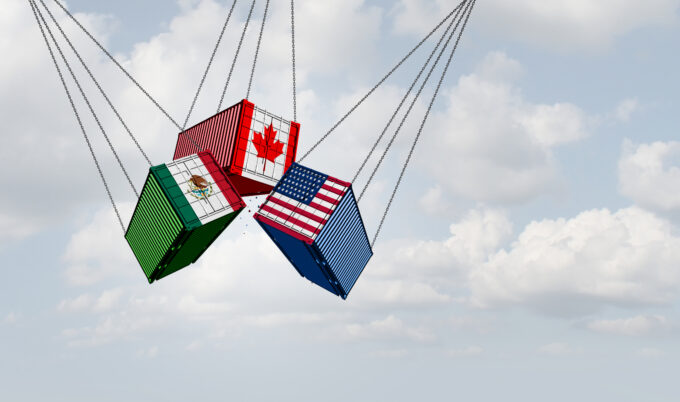
If you import from Mexico or Canada, manufacture in North America, or move goods across the U.S.-Mexico-Canada border, you have probably noticed something uncomfortable:
The future of USMCA is no longer a “wait and see” issue.
The United States-Mexico-Canada Agreement was designed to strengthen North American trade, encourage regional manufacturing, and create a framework for goods genuinely produced in the region to receive preferential tariff treatment.
But USMCA is entering a new chapter—one involving negotiations, tighter scrutiny of rules of origin, concerns about Chinese content, transshipment, tariffs, and the future of North American supply chains.
And if you thought rules of origin were already complicated, grab a cup of coffee (or a bottle of wine). The next chapter could make Customs and Border Protection very interested in your bill of materials.
USMCA Has Entered a New Chapter
USMCA replaced NAFTA in 2020 and created a modern framework for North American trade, including provisions covering manufacturing, agriculture, automotive production, labor, digital trade, and integrated supply chains.
The agreement’s first mandatory Joint Review took place on July 1, 2026. The three countries can extend the agreement for another 16 years. If they do not agree to extend it, the agreement moves into annual reviews and can ultimately expire in 2036.
The United States chose not to automatically extend it, opening the door to negotiations over important elements of North American trade.
So, is USMCA going away?
Not tomorrow.
But businesses should not interpret that as “nothing to worry about.”
U.S. officials have indicated that negotiations will continue, with interim arrangements potentially being pursued while more complicated issues take longer to resolve.
That uncertainty can affect purchasing decisions, supplier contracts, inventory planning, pricing, manufacturing locations, customs compliance, transportation costs, capital investment, and customer commitments.
In other words, USMCA may be negotiated in Washington, Ottawa, and Mexico City, but the consequences can land directly on your spreadsheet.
The China Question: Is Your North American Supply Chain Really North American?
One of the biggest issues facing USMCA is the treatment of non-North American goods and inputs, particularly Chinese-origin goods.
Here’s the key point:
Shipping a Chinese product through Mexico or Canada does not automatically make that product a USMCA-originating good.
USMCA rules generally require goods to meet applicable rules of origin. Depending on the product, those requirements can involve tariff-classification changes, regional value-content requirements, specific processing requirements, or other product-specific rules.
Geography alone does not create origin.
A shipment can travel from Shanghai to Vancouver, take a scenic drive through Toronto, and eventually arrive at the U.S. border, but the itinerary does not magically transform Chinese origin into Canadian origin.
Customs is interested in what happened to the product, not simply where it stopped for lunch.
That distinction is becoming increasingly important as the United States focuses more heavily on transshipment, tariff evasion, non-North American inputs, and the possibility that Chinese-origin goods could enter the United States through Canada or Mexico while attempting to benefit from USMCA preferences.
There is a legitimate difference between:
North American manufacturing using globally sourced inputs
and
using Mexico or Canada as a pass-through location for Chinese goods.
The first can be a normal part of a modern global supply chain.
The second is likely to attract increasing scrutiny.
“Assembled in Mexico” Does Not Automatically Mean “Qualifies for USMCA”
This is where companies need to move beyond a basic question:
“Where was the product assembled?”
and start asking:
“Does the production process actually satisfy the applicable USMCA rule of origin?”
Those are very different questions.
USMCA Chapter 4 establishes the basic framework for determining whether goods qualify as originating.
A good may qualify when it is wholly obtained or produced in a USMCA country, produced using non-originating materials while satisfying the applicable product-specific rules, or otherwise meeting the agreement’s requirements.
That means a Chinese component isn’t automatically disqualifying.
But neither does putting that component into a box in Mexico suddenly make it Mexican.
The actual manufacturing process matters.
For some products, the required transformation may be substantial. For others, the rules may permit certain non-originating materials if specified tariff shifts or regional value-content thresholds are satisfied.
The classification of the finished product and its components can therefore become extremely important.
“Assembled in Mexico” and “Qualifies for USMCA” are not interchangeable statements.
Transshipment Is Not the Same as Manufacturing
USMCA also contains provisions addressing transit and transshipment.
An originating good can retain its originating status when transported outside the USMCA countries under certain conditions, including remaining under customs control and not undergoing unauthorized production or operations outside the agreement’s territory.
That matters because legitimate logistics activity does not automatically destroy origin.
But it reinforces the larger principle:
USMCA preferential treatment is based on satisfying the agreement’s rules, not simply finding a creative shipping route.
For companies sourcing from China and manufacturing or assembling in Mexico or Canada, the documentation trail may become just as important as the manufacturing process itself.
Rules of Origin: The Trade Compliance Homework Nobody Asked For
Rules of origin determine whether a product qualifies for preferential treatment under USMCA.
Sounds simple, right?
Of course not.
This is international trade.
Depending on the product, rules can involve:
- Regional value content
- Tariff-shift requirements
- Specific processing requirements
- Automotive content
- Labor value content
- Steel and aluminum requirements
Product-specific rules
These requirements can change the economics of where a company sources materials and manufactures products.
And that is why companies cannot simply rely on a supplier’s statement that a product is “USMCA compliant.”
The better question is:
Can we prove it?
Automotive Could Be a Major Battleground
The United States has been pushing for stronger North American content requirements, particularly in the automotive sector. Automotive products are likely to remain one of the most important areas of discussion.
North American automotive manufacturing is deeply integrated. A vehicle can cross borders multiple times before reaching the customer, with components sourced from suppliers across all three countries.
Change the rules of origin, and the impact can ripple through the entire supply chain.
Manufacturers may need to reconsider:
Where components are sourced
- Where production occurs
- How much regional value is incorporated
- Supplier qualification
- Certification procedures
- Recordkeeping
- Customs documentation
For manufacturers, that could create both challenges and opportunities.
For customs professionals, it creates something else:
More spreadsheets.
Because apparently building a vehicle wasn’t complicated enough already.
The Bottom Line for Part 1
The fundamental issue facing businesses is becoming increasingly clear:
Where a product is shipped from is not necessarily the same as where that product originates.
A company cannot assume that moving Chinese goods through Canada or Mexico, or performing limited assembly there, automatically creates USMCA eligibility.
Businesses need to understand the applicable rule of origin, identify non-originating inputs, evaluate the manufacturing process, and determine whether they can substantiate their claims.
And that brings us to the next question:
Even if a product qualifies for USMCA, what other tariff and compliance risks could still affect the bottom line?
Is Your Product Really USMCA-Ready?
Don’t wait until Customs asks questions to find out whether your products actually qualify for USMCA treatment.
Now is the time to look beyond the shipping label and examine what’s really inside your supply chain.
Take a closer look at your suppliers, components, manufacturing processes, tariff classifications, and country-of-origin information. If Chinese-origin materials are part of your supply chain, understand how they affect your USMCA qualification and potential tariff exposure.
Can you prove that your products qualify or are you simply assuming they do?
Export Solutions can help you take a closer look at your products and identify potential rules-of-origin and compliance concerns before they become costly problems. Contact us today to schedule a no-charge consultation.
Because when it comes to USMCA, “We thought it qualified” isn’t a compliance strategy.
Read Part 2 and Part 3 where we examine tariffs, documentation, verification, and what businesses should expect as the future of USMCA takes shape.
Shawna Karajic is a Senior Consultant for Export Solutions -- a full-service consulting firm specializing in U.S. import and export regulations.