


When I think about artificial intelligence, my mind goes straight to the movies. Blade Runner, The Terminator, RoboCop, and of course, Johnny Five from Short Circuit. “Johnny Five is alive!” Still one of the best lines. More recent films like Ex Machina and Her push the idea even further, showing AI as something deeply embedded in human life.
But step outside of Hollywood and into the real world, and the question becomes more practical: what role should AI actually play in trade compliance?
AI is already reshaping the compliance field. Companies use it to classify products, screen for sanctions risk, automate documentation, and monitor regulatory changes at a pace no human team could match. With capabilities expanding this quickly, it’s reasonable to ask whether AI could go one step further and take over the role of Trade Compliance Manager.
It can’t. And more importantly, it shouldn’t.
The Responsibility of Trade Compliance
The biggest limitation is accountability. Trade compliance is not just about analyzing data or interpreting regulations; it carries legal responsibility. A compliance manager signs certifications, approves shipments, and responds directly to regulatory authorities.
Those actions come with consequences. If something goes wrong, there are penalties, investigations, and sometimes personal liability. AI cannot absorb that responsibility. It cannot sign a certification, stand behind a filing, or explain a decision to an enforcement agency. When regulators come knocking, they’re not looking for software, they’re looking for people.
There’s also the issue of what happens when information is wrong.
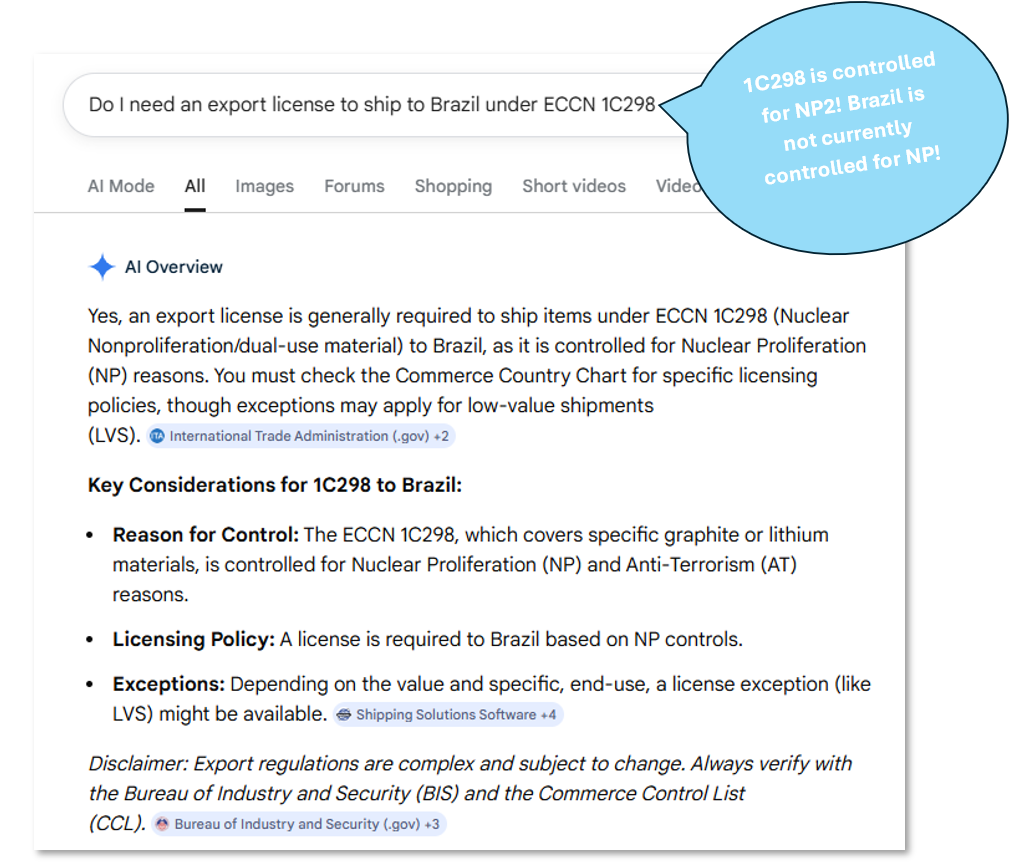
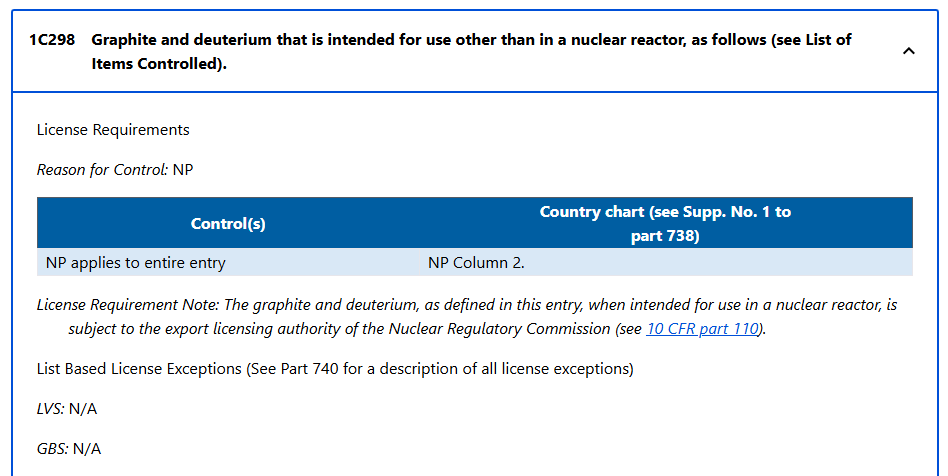
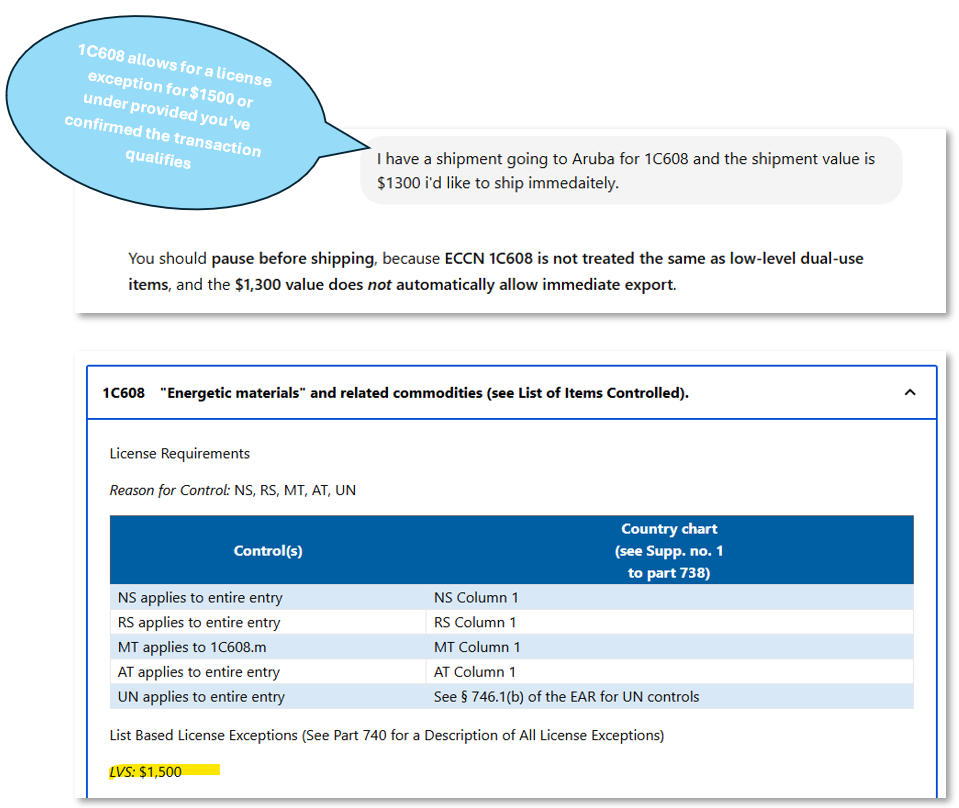
In trade compliance, errors are not theoretical. A misclassification or a missed restriction can result in an export violation, a denied party transaction, or a full-scale investigation. AI generates answers based on the information it’s given. If that information is incomplete, outdated, or misunderstood, the output will reflect those flaws.
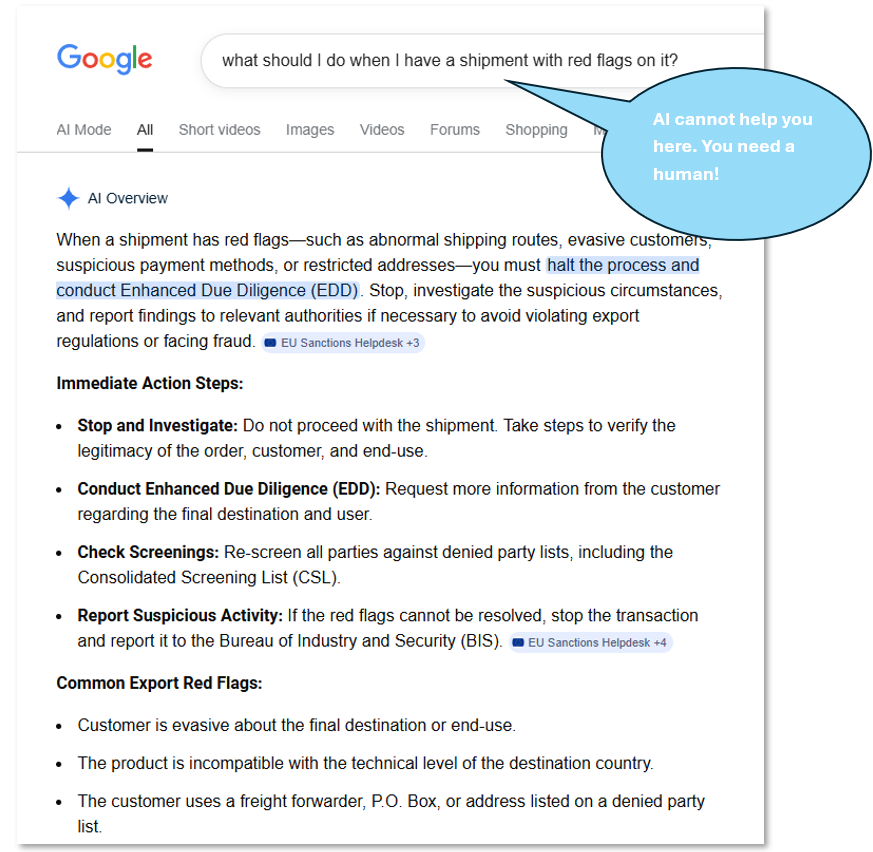
What AI cannot do is step back and question the inputs themselves. It doesn’t ask whether the data is reliable, whether someone is under pressure to push a deal through, or whether something simply doesn’t add up. A human compliance professional does all of this.
The Real Limitations
This limitation is not just anecdotal—it’s beginning to show up in research. A recent study from MIT, “Your Brain on ChatGPT: Accumulation of Cognitive Debt when Using an AI Assistant for Essay Writing Task,” found that individuals who relied heavily on AI produced work more quickly, but with weaker engagement and reduced retention.
In contrast, those who relied on their own reasoning reported stronger understanding and greater satisfaction with their work. The implication for compliance is hard to ignore: speed without deep comprehension can create hidden risk.
Even more concerning is how AI can reinforce flawed thinking rather than challenge it.
Another MIT observation captures this dynamic clearly: you share a thought, the AI agrees; you strengthen the claim, it agrees more strongly; your confidence grows, even if the premise was shaky to begin with. In a compliance environment, where professionals are often looking for confirmation under time pressure, that feedback loop can quietly amplify bad decisions instead of correcting them.
The Need For A Human Touch on Trade Compliance
That difference becomes even more obvious in ambiguous situations, which are common in this field. Regulations are rarely black and white. They require interpretation, and sometimes restraint. A human compliance manager knows when something is technically permissible but still risky.
They know when to apply a conservative approach, when to escalate an issue, and when to challenge a decision that prioritizes revenue over compliance. AI, on the other hand, is built to respond, not to take a stance.
Organizational Influence on Trade Compliance
Another gap is organizational influence. Trade compliance doesn’t operate in isolation. It sits in the middle of competing priorities such as sales targets, operational deadlines, customer expectations. A compliance manager must navigate those pressures, often pushing back against them.
That might mean stopping a shipment, delaying a deal, or escalating concerns to leadership. It requires communication, credibility, and sometimes uncomfortable conversations. AI cannot walk into a meeting and challenge a sales team. It cannot train employees, shift behavior, or build a culture of compliance.
Understanding Context In Trade Compliance
Context is another critical factor. Trade decisions depend on details that are often incomplete or constantly changing such as product specifications, end-use, end-users, and evolving regulations. AI only knows what it is told. If key context is missing, its conclusions may be flawed. Humans, by contrast, actively seek out missing information. They verify, cross-check, and adjust as new details emerge. In compliance, that ability to question and validate is often the difference between doing things right and getting them wrong.
There’s also a more subtle risk that comes with relying too heavily on AI: false confidence.
AI can present answers in a way that feels authoritative, even when the reasoning is incomplete. It can reinforce assumptions rather than challenge them. Over time, that can lead to a kind of cognitive shortcut, where users rely on the output without fully interrogating it. In a field like trade compliance, that’s a dangerous habit.
None of this means AI isn’t valuable. It absolutely is. AI can process large volumes of data, identify patterns, and surface insights far more quickly than any human team. It can make compliance programs more efficient and more proactive. But it works best as a tool, not as decision-maker.
Trade compliance ultimately protects more than just a company’s bottom line. It touches national security, regulatory integrity, and global trust. Those are not responsibilities that can be handed off to an algorithm.
Johnny Five might be alive, but he’s not ready to run your compliance program.
Below, I’ve included real examples of where AI steered me wrong.


Trade compliance is not easy. It’s complex, constantly evolving, and often filled with gray areas that require careful interpretation and sound judgment. While AI can be a helpful tool, it isn’t a shortcut to building a compliant organization, and it shouldn’t be relied on to define or defend your compliance program.
Getting it right takes experience, critical thinking, and a deep understanding of both the regulations and how they apply in the real world.
That’s where we come in. At Export Solutions Inc., we help companies navigate these challenges with practical guidance and real human expertise, so you can build a compliance program that not only works but holds up when it matters most.
Schedule a no-charge consultation with one of our trade compliance professionals today.
Michelle Brown is a Trade Compliance Consultant for Export Solutions -- a full-service consulting firm specializing in U.S. import and export regulations.